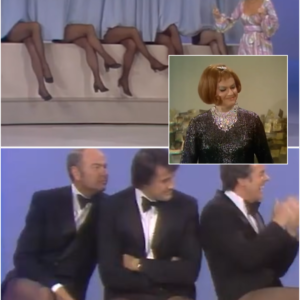
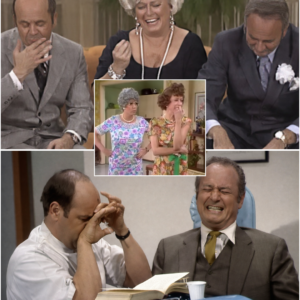
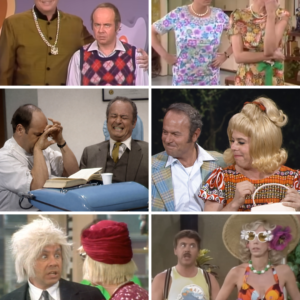
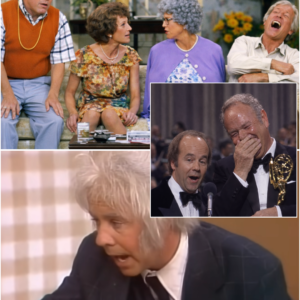
It was supposed to be the calmest shift of the week—Harvey Korman barking out a few orders, Carol Burnett giving the line a quick check, and Tim Conway minding his own business while tightening a couple of bolts. Simple. Easy. Boring, even. But the moment Tim stepped near that conveyor belt, the whole factory floor turned into a battlefield. The machine locked onto him like it had a personal grudge, yanking him, spinning him, and stripping away every last drop of dignity he had left.

The Factory Floor & The Fallout
Picture it: mid-sense factory hum, conveyor belt whirring, drills spinning, alert foreman calls out the next batch. And into this mechanical monotony steps Conway, suited up for productivity but gifted with the comedic instinct for calamity.

He’s not just a man doing a job—he’s a man whose job is done to him. The belt moves. The drill buzzes. His eyebrows rise. The audience knows: this won’t end with a clean shift.

The Core Gag — Conway vs. The Machine
Conway’s genius here lies in his intensity of inaction. While the factory moves at full speed, he attempts to keep pace—but something is always slightly wrong:

His drill bit doesn’t align.

A bolt flies through the air.

The belt speeds up.
Yet his face remains stoic, his voice calm, his body framed in the perfect “worker about to lose it” posture.

Every second builds: he tries to stay professional. He tries to apologize. He tries to love his wife (who just left him) while handling the machinery. Then the belt overtakes him, the bolts miss the tray, and suddenly the entire set is an explosion of comedic dysfunction.

The Collapse — When Laughs Overcome Logic
At the moment of collapse, the factory becomes a stage of existential error. He shouts:

“I love you… I’m sorry… I’m terrible…”

All while the drill keeps spinning and the belt keeps moving. The contrast is electric: a life unraveling at industrial speed. The audience doesn’t just laugh—they wince. Because somewhere between the nuts and bolts, they recognise the absurdity of work, love and everything in between.

The Legacy — Why This Sketch Still Holds Up
Why does this still work decades later? Because Conway elevates routine failure into art.

He doesn’t mock the worker—he is the worker.

He doesn’t insert surreal chaos—the chaos is real.

And the conveyor belt? It becomes a metaphor: for jobs, for life, for the things we can’t stop.

In a world of grand slapstick, Conway reminds us: the smallest misalignment, the quietest sigh, the faintest “I’m sorry” can be more devastatingly funny.

Emotional Echo — The Drill, The Belt, The Human
As the drill whirs, and parts fly, Tim Conway stands at the intersection of man and machine—with the weight of expectation on his shoulders. He doesn’t win. He survives. And we laugh because we hope to survive it, too.

Because in every job, behind every belt, there’s a person. And sometimes… the belt wins.

Related Posts

Pimple Treatment At Home

Ear blackheads (video)

Tim Conway had no idea he was about to turn The Carol Burnett Show upside down, but the moment he gasped, “I can’t stop… I just can’t,” everything fell apart in the most unforgettable way. What was meant to be a smooth, Broadway-style musical number suddenly crashed into absolute madness the second the audience saw the male cast lined up in classy tuxedo jackets… paired with skin-tight, neon dance leggings gripping for dear life below.

The duo had the audience in stitches as Harvey Korman played a nervous patient and Conway played the role of the dentist. They don’t make comedians like…

There’s a reason many comedians hesitated before stepping on stage with Tim Conway. He didn’t just stretch the rules — he quietly stepped outside them. A sketch would move along exactly as planned, the timing steady and everything under control. Then Tim would add one small detail that seemed to come from nowhere. No setup, no explanation, just a perfectly misplaced moment. The instant Harvey Korman caught on, it was written all over his face — that split second of confusion, the silent attempt to stay composed while realizing the scene had taken a turn no one planned for. The laughter that followed wasn’t rehearsed. It was pure reflex. From that moment forward, the sketch belonged to chaos in the best possible way — driven by raw timing, genuine reactions, and a style of comedy that could never be duplicated the same way twice.

There was a quiet truth backstage on The Carol Burnett Show: if Tim Conway was in the sketch, no rehearsal truly mattered. The writers could polish every…

I’m convinced Tim Conway had one secret mission: dismantle Harvey Korman — slowly, mercilessly, and with exquisite politeness. One shuffle at a time. You’ve never seen a silent comedy duel like this. Tim moves in near–slow motion: a blink, a tiny step, a careful reach for the ship’s wheel… and Harvey is already gone. Gasping. Wheezing. Folding in on himself like he just sprinted a marathon in clown shoes. It’s surgical. Every pause lands like a punchline. Every shuffle becomes a weapon. Every stretch of silence tightens the trap. The studio is finished. The cast is finished. The crew is finished. Everyone’s doubled over, fighting for air — except Harvey, who’s trapped in the most polite nightmare imaginable, plotting revenge while begging for mercy. Patience doesn’t just disappear — Tim turns it into a weapon of mass hilarity. Watching him work feels like a masterclass in comedy, disguised as the gentle destruction of one man’s dignity. And the best part? There’s a behind-the-scenes detail from this sketch that fans swear is even funnier than what actually made it to air.

And then there is Tim Conway and Harvey Korman, a pair so perfectly mismatched in discipline and chaos that every sketch they touched became instant television history….

Twelve minutes that shattered live television — Tim Conway slowly dismantles Harvey Korman while America loses it. It was a Saturday night. The popcorn was warm, the living room glowed blue from the TV, and then The Carol Burnett Show slipped into full-blown chaos. With surgical patience, Tim Conway took his time — stretching every pause, milking every look — until Harvey Korman had absolutely no defense left. From The Oldest Safecracker to The Oldest Surgeon, the laughter wasn’t written into the script. It was unavoidable. You could feel it building, second by second, and that anticipation made the payoff even sweeter. From an American living-room point of view, this wasn’t just comedy. It was a shared ritual — a moment when television pulled families together and laughter felt truly communal.

Remember those Saturday nights? We’d settle in front of the TV, the living room aglow with anticipation, for another episode of “The Carol Burnett Show.” Oh, those…

Leave a Reply

Your email address will not be published. Required fields are marked *