1) Live Television, and a Hand That Wouldn’t Stop Shaking
On November 14, 1985, the kind of night that usually ran like a perfectly rehearsed machine, The Tonight Show went briefly off the rails—right in front of 300 people inside NBC Burbank Studios, and millions more watching from their living rooms across America.
Johnny Carson’s hand was shaking.
It wasn’t the subtle tremor of fatigue, not the nervous flutter of a guest who’d missed a cue. The cue cards in his grip trembled like leaves in a storm. The studio lights stayed bright, the cameras stayed trained, the band waited for its next beat—and the man who had guided America to bed with laughter for 23 years could not speak.
His face had gone pale. His eyes were wet. And as the seconds slipped past, something unthinkable happened: the sound in the room drained away until there was nothing but an awareness of being live.
Ed McMahon rose from his chair, instinctively, as if he could steady the moment with his own body. The band stopped playing. Somewhere above the set, the director’s voice crackled through Johnny’s earpiece—urgent, clipped, confused.
“Johnny. Johnny, you’re live. Talk to us.”
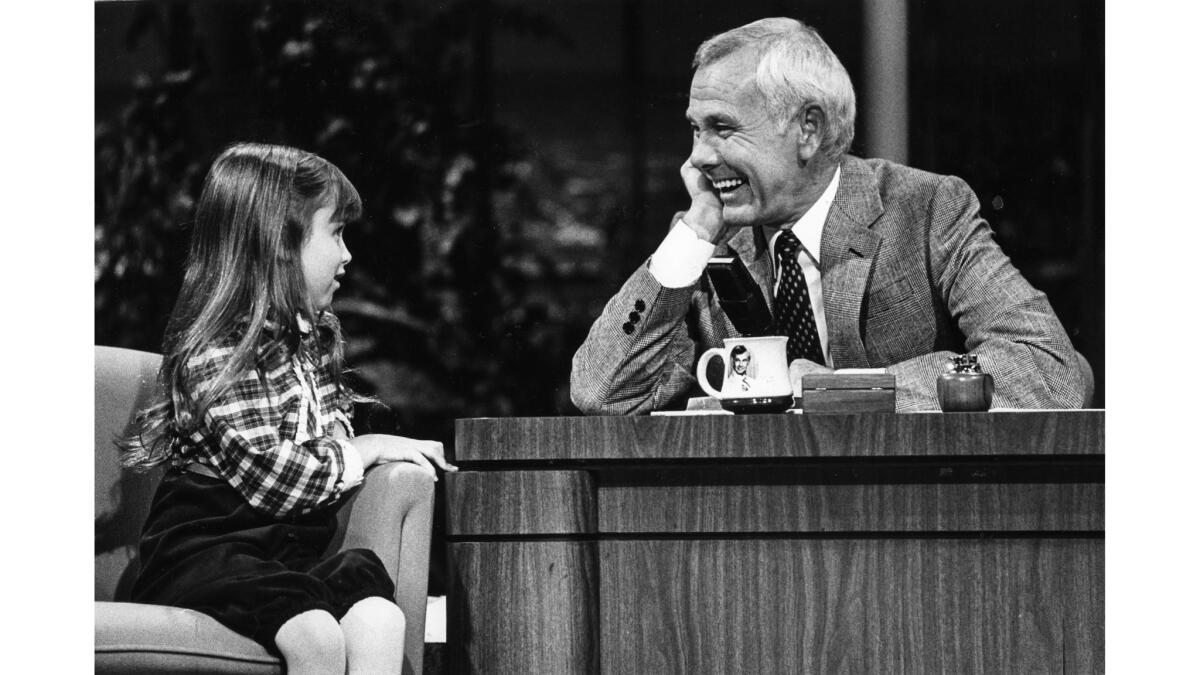
But Johnny Carson wasn’t listening. He wasn’t looking at the cameras. He wasn’t looking at Ed. He was staring at a child standing at the front of the stage—a seven-year-old girl, small enough that the edge of the platform seemed like a wall in front of her.
She wore a blue dress two sizes too big, the hem swallowing her knees. On her tiny arm hung a man’s wristwatch, loose enough to slide down toward her hand. And she clutched a folded piece of paper as if it were the most important thing in the world.
She had just whispered something to Johnny Carson.
Whatever it was, it broke him.
The audience sat frozen, eyes wide, bodies held in the same posture of disbelief. This was Johnny Carson—the king of late night, the man who had done this 11,000 times before, the man who never lost his composure. He had walked into disasters and walked out with jokes. He had tamed awkward guests, dead jokes, broken props. He had turned silence into timing.
Now tears streamed down his face.
For thirty seconds, there was dead air.
Thirty seconds is an eternity in television. It is a long hallway with no doors. It is the longest silence in Tonight Show history, and everyone inside Studio 1 understood it the same way at once: something real had entered the room, something too heavy for show business to carry like a trick.
The question that hung in the studio—quiet, electric—was simple.
What could a seven-year-old girl say that brought Johnny Carson to his knees on live television?
The answer began eight weeks earlier, in a small home in Pasadena, with a man who wasn’t famous, wasn’t rich, and yet had built his entire sense of survival around the sound of Johnny Carson’s laughter.
2) Emily Warren and the Watch That Didn’t Fit
Her name was Emily Warren—seven years old, brown hair, big eyes that looked too large for someone so young, as if grief had widened them. In the weeks before she walked into NBC’s bright studio, her world had already collapsed in a way adults still struggle to name.
Her father, Michael Warren, was 34. He worked as a high school janitor in Pasadena, California. He wasn’t a man who collected headlines or invitations. He was a man who clocked in, worked hard, came home tired, and tried to make a small life feel lighter.
Michael Warren had one obsession—one thing that made him happy no matter how hard his day had been:
The Tonight Show Starring Johnny Carson.
Every single night, Michael would sink into his worn-out recliner with Emily on his lap and watch Johnny’s monologue. He knew every gesture, every pause, every rhythm. He would repeat punchlines at dinner until Emily’s mother rolled her eyes and laughed. He would practice Johnny’s golf swing in their tiny backyard as if it were a sacred ritual, as if he could borrow a little of Johnny’s ease and bring it back into his own life.
One night Emily asked him a question children ask when they sense someone’s devotion but don’t yet understand it.
“Why do you love Johnny so much, Daddy?”
Michael’s answer was simple and devastating in its honesty.
“Because when I watch him, I forget that life is hard. He makes me believe that no matter how bad things get, there’s always something to smile about.”
That wasn’t a fan’s line. It was a lifeline. Michael Warren wasn’t watching a celebrity. He was watching a compass—proof that joy could exist even when the day had been heavy.
Three months before everything ended, Michael did something that felt reckless for a man with his kind of life. He entered a radio contest. He called in over 200 times in one weekend, and against the odds that usually favor people with more time and more luck, he won.
Two front-row tickets to a taping of The Tonight Show.
He screamed so loud the neighbors came running. He grabbed Emily and spun her around the kitchen until her feet lifted off the ground.
“We’re going to see Johnny, baby girl—front row,” he told her. “We’re going to be so close we can see him breathe.”
Emily had never seen her father so happy. The house glowed with his excitement as if he’d brought in extra light just by believing in something.
Then September 15 happened.
A drunk driver ran a red light on Colorado Boulevard and hit Michael’s car on the driver’s side. Michael Warren was pronounced dead at the scene.
Emily was supposed to go with him that day. A last-minute cold kept her home. That small twist—ordinary, harmless—became a permanent hinge in her memory. She never got to say goodbye.
But Michael had left something behind.
The tickets were still in his nightstand—two front-row seats to the show he loved most.
And one of them still had his name printed on it.
When November 14, 1985 came around, the tickets were still valid.
Nonrefundable. Nontransferable.
They were, in a way, a final dare from fate: go without him, or let the dream die with him.
Emily’s mother, Karen, didn’t know what to do. Throwing them away felt like throwing away the last piece of her husband’s happiness. Going without him felt impossible.
Emily made the decision for her.
“I want to go, Mommy.”
Karen looked at her daughter—this tiny girl who hadn’t smiled since the funeral, who barely ate, who woke up crying at night calling for a father who would never come.
“Honey,” Karen said, “it might be too sad.”
Emily shook her head.
“Daddy wanted to take me. If we don’t go, his dream dies, too. I don’t want his dream to die, Mommy.”
Karen broke down. It was the kind of sobbing that comes from surrendering to a child’s clarity. Her seven-year-old daughter was thinking more clearly than any adult in the room.
They would go.
The night before the taping, Karen found Emily sitting on her bed under a small lamp, holding a piece of paper and writing carefully—slowly—concentrating hard on every word as if each letter mattered.
“What’s that, baby?” Karen asked.
Emily folded the paper and slid it into her pocket.
“It’s for Johnny.”
Karen assumed it was a drawing—a child’s thank-you note. She didn’t push. She should have, but grief makes people move around truths like they’re fragile glass.
The night of the taping, Emily insisted on wearing her father’s watch.
It was too big for her wrist. She wrapped tape around it just to keep it from sliding off. It was heavy, awkward, a man’s timepiece on a child’s arm. But she wouldn’t go without it, as if the weight of it could anchor her father to the night.
The drive to Burbank was silent. Emily sat in the back seat clutching the folded paper and staring out at city lights her father would never see again.
And when they arrived at NBC Studios, the energy around them felt like an entirely different world—people laughing, people excited, the hottest ticket in television.
Emily didn’t smile.
They took their seats.
Front row.
The seats Michael had won.
And beside them, one empty space where he should have been.
Karen whispered toward that emptiness, trying to make it livable.
“Daddy’s watching from heaven, sweetheart.”
Emily nodded slowly.
“I know, Mommy. That’s why I have to give Johnny the letter.”
Karen froze.
“What letter, Emily? What did you write?”
Before Emily could answer, the lights dimmed. The band started playing. Ed McMahon’s voice boomed through the studio:
“Here’s Johnny!”
And Johnny Carson walked through the curtain.
3) The Monologue That Couldn’t Reach Her Eyes

The monologue went perfectly at first.
Johnny Carson was on fire—political jokes landing, celebrity impressions getting big laughs, the audience eating out of his hand the way they always did when he found the groove. His timing was as familiar as breathing. For viewers at home, it was a normal Thursday night: Johnny making it all feel easy.
But something kept pulling Johnny’s attention away from the routine.
A little girl in the front row.
She wasn’t laughing. She wasn’t smiling. She wasn’t doing anything the audience does when it’s being delighted. She was just staring at him—big brown eyes locked onto him with an intensity that didn’t belong on a child’s face, like she was waiting for something important to happen.
Johnny kept going. He was a professional. He had done this thousands of times.
And still, every few seconds, his eyes drifted back to her.
Something about the oversized watch on her tiny wrist.
Something about the way she clutched that folded paper.
Something about the empty seat beside her.
Johnny finished the last joke of the monologue. The audience erupted in laughter and applause. And in that brief pocket of silence when a show typically resets itself for the next beat, the little girl stood up.
Karen grabbed her arm.
“Emily, no.”
But Emily was already moving—walking toward the stage with a steadiness that startled the room. Security stepped forward, but Johnny lifted his hand.
“Wait,” he said. “Let her come.”
The audience went dead quiet.
Johnny walked to the edge of the stage and knelt down until he was at Emily’s level. His knees cracked. He didn’t care.
“What’s your name, sweetheart?” he asked.
Her voice was tiny but steady.
“Emily.”
Johnny smiled gently, still trying to keep the moment light.
“Well, that’s very kind,” he said, and then, seeing her seriousness, he softened further. “Is your daddy here tonight?”
Emily shook her head.
“He died two months ago,” she said. “A car accident.”
The audience gasped—a sound like a collective hand to the mouth.
Johnny’s smile disappeared. His face tightened in that way it did when he had to leave comedy and enter something real.
“I’m so sorry, Emily,” he said, and he began to offer the phrase people offer when they want to help: I’m sure he’s watching from—
Emily cut through it—not rudely, but urgently.
“He wrote you a letter.”
She held up the folded paper.
“Before he won the tickets, he wrote this. He said if he ever met you, he wanted you to read it. He never got to meet you, so I brought it for him.”
Johnny stared at the paper, then at Emily, then back at the paper. He took it gently, as if it might tear under the weight of what it carried. He unfolded it.
The audience watched as Johnny Carson began to read.
At first, his face stayed calm and professional—an entertainer absorbing a note. Then something shifted. His eyebrows pulled together. His lips pressed tight. His jaw clenched, the way it did when he was trying to control emotion before it escaped.
He kept reading.
And then Johnny Carson’s hands started trembling.
Ed McMahon stood up again.
“Johnny…”
In Johnny’s ear, the director’s voice sharpened with fear.
“Johnny, we’re live. What’s happening?”
Johnny didn’t respond. He couldn’t. His eyes filled with tears. He tried to speak.
Nothing came out.
The man who had entertained America for decades—who had never broken character on live television—was crying. His shoulders shook. He covered his mouth with his hand. The letter trembled in his grip.
Three hundred people sat in complete silence.
Emily stepped closer. She reached out and touched Johnny’s hand with her small fingers, gentle as a question.
“Daddy said you would understand, Mr. Carson,” she whispered. “He said, ‘You were the only person in the world who would understand.’”
Johnny looked at her through tears. His voice came out cracked, barely a whisper.
“Emily… your father… I had no idea.”
The studio held its breath. The cameras stayed locked. The lights stayed bright. And in the middle of America’s most familiar show, something unfamiliar happened: truth arrived.
4) The Letter That Opened a Hidden Door

Johnny Carson lifted his eyes from the page and looked out at the audience—then back at Emily—then back at the letter. His hands were still shaking, but his voice began to find a shape.
“I need to tell you something,” he said, the words slow, careful. “I need to tell you who this little girl’s father really was.”
He held up the paper.
“Michael Warren,” Johnny said, “a janitor from Pasadena. A man I never met… but a man who just taught me something I’ll never forget.”
The audience leaned forward. In the front row, Karen’s hands were pressed to her mouth, her shoulders trembling.
Johnny read parts of the letter aloud. As he did, the story inside it unfolded like a secret that had waited thirty years to be spoken.
“Mr. Carson,” Johnny read, “you don’t know me, but you saved my life when I was 12 years old.”
The studio stayed so quiet the words felt louder than applause ever had.
“In 1955,” Johnny continued, “my father died in a factory accident in Nebraska. I was lost. I stopped talking. I stopped eating. My mother didn’t know what to do with me.”
Johnny paused, swallowing hard, and read on.
“One night she left the television on and your show came on. I watched your monologue and for the first time in three months I laughed.”
Johnny’s voice cracked. His eyes squeezed shut for a second, as if the sentence had found him personally.
“That laugh saved me, Mr. Carson,” he read. “It reminded me that joy could exist even when everything hurt. I’ve watched your show every single night since then. Thirty years. You’ve been there for me when no one else was.”
Johnny lowered the letter slightly, blinking hard.
And then came the line that tore the room open.
“And now I’m dying.”
The audience gasped again—this time louder, as if the first gasp had only been practice for the second.
Johnny continued, voice trembling, reading the words a man had written while counting his remaining time.
“I have cancer, Mr. Carson. The doctors say I have a few months, but I’m not scared because you taught me that even in the darkest night, there’s always a reason to smile.”
Johnny wiped his eyes with the back of his hand, but the tears kept coming.
“I won’t get to meet you,” he read, “but my daughter will. Please tell her that her daddy loved her. And please tell her that laughter is how we survive.”
The letter wasn’t asking for money or attention. It wasn’t even asking for a meeting. It was asking Johnny Carson to do what he had always done—take pain and make it bearable, not by pretending it wasn’t there, but by reminding someone that surviving it was possible.
Johnny lowered the paper completely and looked at Emily.
“Your father didn’t die in that car accident by chance, Emily,” he said, his voice full of grief and something like awe. “He was already sick. He knew he didn’t have much time, and his final wish wasn’t for himself.”
Emily’s eyes filled with tears. The watch on her wrist slid down toward her hand.
“It was for you.”
Johnny knelt down again and held both her hands.
“Your daddy spent his whole life learning how to smile through pain,” he told her. “And now he wants you to learn the same thing. Not because life isn’t hard… but because laughter is how we keep going.”
Emily whispered, small and raw, “He really loved you, Mr. Carson.”
Johnny nodded.
“And I really love him, too,” he said, “even though we never met. Because anyone who understands what laughter really means is family to me.”
It was an impossible sentence for late-night television—too sincere, too exposed. And yet it landed perfectly, because the truth was that Johnny Carson’s job had always been to sit in America’s living rooms and convince strangers they weren’t alone.
Now a stranger had reached him back.
5) A Pocket Square and a Promise

Johnny Carson stood up slowly, still holding the letter. He looked out at the audience—faces wet, hands covering mouths, people blinking hard like they could blink the moment away. Then he looked down at Emily again, as if deciding something.
He reached into his jacket pocket.
He pulled out his signature pocket square—navy blue with white edges, the same kind he’d worn for years, folded the same way night after night. It was a small object, almost nothing in material terms, but in that studio it carried the weight of ritual. It was part of Johnny’s uniform, part of the image America trusted.
He folded it carefully and placed it into Emily’s hands.
“I want you to have this, Emily,” he said. “Every night I do this show, I wear one of these. Whenever you miss your daddy, hold this and remember that somewhere out there, someone is trying to make people smile… just like your father wanted.”
Emily clutched it as if it were made of gold. Her fingers tightened around the fabric. The watch on her wrist glinted under the stage lights.
Johnny walked her back to Karen, who was sobbing so hard she couldn’t speak. Johnny leaned in and whispered to her—quiet, private, almost tender in the way a man speaks when he doesn’t want cameras to own the moment.
“Your husband was a hero, ma’am,” he said. “Emily’s going to be just fine.”
Then he turned to the audience, his voice steadier now—not because the emotion had left, but because he had decided to carry it.
“We’re going to take a short break, folks,” Johnny said, “but I want you to remember something tonight. The people who love us never really leave. They just find new ways to reach us.”
He held up the letter one last time, letting it be seen without being exploited.
“Michael Warren reached me tonight,” he said, “through a letter and the bravest little girl I’ve ever met.”
The audience rose into a standing ovation. Three hundred strangers crying and clapping, some hugging each other as if they’d just survived something together—which, in a way, they had. The band, when it returned, sounded softer, as if even music understood it shouldn’t interrupt grief too loudly.
During the commercial break, Johnny asked his producer to bring Emily and Karen backstage after the show.
And when they arrived, he had one more gift waiting in a quiet room lit by a warmer, less public kind of light.
A framed photo of himself, signed personally.
The inscription read:
“For Emily and Michael Warren, your daddy taught me something tonight. Keep laughing forever. With love, Johnny Carson.”
Then Johnny made a promise—one that sounded impossible and yet came out of him like a vow.
“Emily,” he said, “every year on your birthday, I’m going to dedicate a joke to your father. So wherever you are, you’ll know that someone remembers him.”
It wasn’t a contract. It wasn’t a publicity line. It was a human promise made in the aftermath of thirty seconds of silence.
And, remarkably, Johnny Carson kept it.
Every year, on Emily’s birthday, he dedicated a joke to Michael Warren—until the day he retired.
6) The Things Emily Framed, and the Watch That Finally Fit
Emily Warren grew up.
Time, relentless and indifferent, did what it always does: it moved forward whether the heart wanted it to or not. The blue dress got packed away. The pocket square stayed. The letter stayed. The watch—her father’s watch—stayed too.
Emily Warren is 46 years old today. She works as a grief counselor in Los Angeles, specializing in helping children who have lost parents. It isn’t hard to imagine why she chose that work: because she knows the exact shape of a child’s sorrow, the way it sits in the body, the way it changes how light looks in a room.
Every day, she uses her father’s story to show children that healing is possible—not quick, not clean, but possible.
On her office wall hangs Johnny Carson’s pocket square in a gold frame. Next to it, the signed photograph. Beside that, a copy of her father’s letter. These aren’t decorations. They’re anchors—proof that love can travel across distance and status, proof that a janitor from Pasadena can reach the most famous man in America with a few honest lines on paper.
Emily still wears Michael’s watch.
It fits now.
That detail—simple, almost quiet—matters. The watch that once slid down her arm and needed tape has finally found its place, as if time itself had taken decades to catch up with her.
Every year on her birthday, Emily watches old Tonight Show reruns. She tells her patients the same thing Johnny told her that night—words that don’t pretend pain disappears, but insist it doesn’t get the last word.
“Laughter isn’t about forgetting pain,” she tells them. “It’s about surviving it.”
Johnny Carson died in 2005.
When Emily heard the news, she wrote a letter to his widow, Alexis—a simple act that mirrored her father’s, as if gratitude also had a shape and a route.
A month later, Alexis replied.
“Johnny never forgot you, Emily,” she wrote. “He talked about that night often. He said your father’s letter reminded him why he did what he did for 30 years. Not to be famous, but to help people smile when smiling felt impossible.”
For Emily, that reply wasn’t just comfort. It was confirmation. That night wasn’t a hallucination of grief. It wasn’t a television myth. It was real, and it stayed real in Johnny Carson’s memory too.
7) Seven Years Old Again
Today, Emily has a daughter who is seven years old—the same age Emily was that night.
Last year, they watched the tape together. NBC had given Emily a digital copy decades ago, preserving those thirty seconds of silence and everything that came after. On screen, Studio 1 looks like any other late-night set: bright, polished, controlled. And yet even through the old broadcast quality, the emotion is unmistakable.
Her daughter watched Johnny Carson’s face crumple. She watched Emily—tiny, steady—hold out a folded paper. She watched the pocket square change hands like a transfer of care.
When the tape ended, her daughter asked the question children ask when they see adults collapse into something human.
“Did Johnny really cry, Mommy?”
Emily smiled—small, tired, full of that complicated gratitude that never goes away.
“Yes, baby,” she said. “Because my daddy’s words reached him.”
And that, in the end, was what the night proved in the most public way possible. Not that Johnny Carson was fragile—though he was. Not that fame makes people immune—because it doesn’t. But that love does something strange and powerful: it keeps traveling even after the person who sent it is gone.
A janitor from Pasadena, a little girl in an oversized blue dress, a man’s watch that didn’t fit, a folded letter under bright studio lights, thirty seconds of silence on live television—these are not the pieces of a fairytale. They are the pieces of an ordinary family’s grief colliding with an extraordinary platform.
And the message that survived that collision was the one Michael Warren had built his life around, the one he handed to his daughter through Johnny Carson’s trembling hands:
Laughter isn’t the opposite of pain.
It’s one way people make it through.