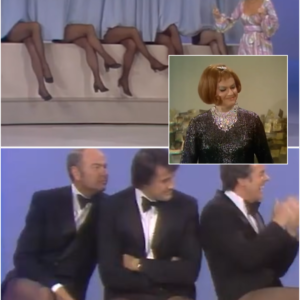
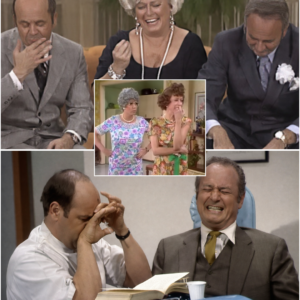
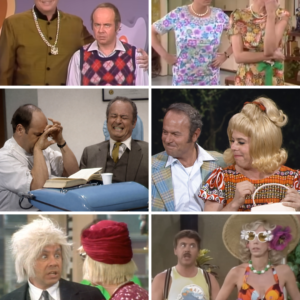
The doctor leaned back in his chair and asked gently, “So… what symptoms are you experiencing?” Tim Conway stared at the ceiling. Not confused. Just thinking. Thinking longer than anyone was comfortable with. The room grew quiet. A clock ticked. A nurse shifted outside the door. Finally, Tim nodded to himself and said, “Sometimes I forget I’m here.” He paused. “But the strange part is… I remember very clearly that I forgot.” The doctor wrote something down. Slowly. Carefully. Then he stopped. Looked up. Removed his glasses. And for the first time that day, the patient wasn’t the one being examined — it was the doctor, laughing at how perfectly Tim Conway had diagnosed life itself.

There’s a particular kind of humor that doesn’t rush toward the punchline. It strolls. It pauses. It lets silence do half the work. Tim Conway mastered that art better than almost anyone, and one imagined visit to a doctor’s office captures exactly why his comedy still feels timeless.

Picture the scene. A quiet examination room. A doctor doing his best to sound professional. He leans back in his chair and asks the standard question every patient hears: “So… what symptoms are you experiencing?”

Tim Conway doesn’t answer right away.

He looks up. Not confused. Not lost. Just thinking — the kind of thinking that stretches a few seconds into something oddly uncomfortable. The clock ticks. The room settles into stillness. Anyone else would rush to fill the silence. Tim lets it breathe.

Finally, he nods, as if he’s reached a careful conclusion.

“Sometimes,” he says calmly, “I forget I’m here.”
A pause.
“But the strange part is… I remember very clearly that I forgot.”

It’s not a joke delivered with a wink. There’s no grin. Just quiet sincerity. And that’s where the magic lives.

The doctor starts writing, doing his job. Then he stops. Looks up. Takes off his glasses. And instead of offering a diagnosis, he laughs — not at the patient, but at the truth hidden inside the absurdity.

Because in that simple line, Tim Conway didn’t just describe a symptom. He described modern life.

We forget where we are. We forget why we walked into the room. We forget what we were worried about five minutes ago. Yet somehow, we’re deeply aware that we’ve forgotten. That awareness — that gentle, human contradiction — is what Tim always knew how to expose.

His comedy never needed volume or speed. It worked because it felt familiar. It sounded like something your own mind might say when no one’s listening.

In that doctor’s office, Tim Conway wasn’t playing a fool. He was holding up a mirror — and laughing softly while the rest of us slowly recognized ourselves in the reflection.

Related Posts

Pimple Treatment At Home

Ear blackheads (video)

Tim Conway had no idea he was about to turn The Carol Burnett Show upside down, but the moment he gasped, “I can’t stop… I just can’t,” everything fell apart in the most unforgettable way. What was meant to be a smooth, Broadway-style musical number suddenly crashed into absolute madness the second the audience saw the male cast lined up in classy tuxedo jackets… paired with skin-tight, neon dance leggings gripping for dear life below.

The duo had the audience in stitches as Harvey Korman played a nervous patient and Conway played the role of the dentist. They don’t make comedians like…

There’s a reason many comedians hesitated before stepping on stage with Tim Conway. He didn’t just stretch the rules — he quietly stepped outside them. A sketch would move along exactly as planned, the timing steady and everything under control. Then Tim would add one small detail that seemed to come from nowhere. No setup, no explanation, just a perfectly misplaced moment. The instant Harvey Korman caught on, it was written all over his face — that split second of confusion, the silent attempt to stay composed while realizing the scene had taken a turn no one planned for. The laughter that followed wasn’t rehearsed. It was pure reflex. From that moment forward, the sketch belonged to chaos in the best possible way — driven by raw timing, genuine reactions, and a style of comedy that could never be duplicated the same way twice.

There was a quiet truth backstage on The Carol Burnett Show: if Tim Conway was in the sketch, no rehearsal truly mattered. The writers could polish every…

I’m convinced Tim Conway had one secret mission: dismantle Harvey Korman — slowly, mercilessly, and with exquisite politeness. One shuffle at a time. You’ve never seen a silent comedy duel like this. Tim moves in near–slow motion: a blink, a tiny step, a careful reach for the ship’s wheel… and Harvey is already gone. Gasping. Wheezing. Folding in on himself like he just sprinted a marathon in clown shoes. It’s surgical. Every pause lands like a punchline. Every shuffle becomes a weapon. Every stretch of silence tightens the trap. The studio is finished. The cast is finished. The crew is finished. Everyone’s doubled over, fighting for air — except Harvey, who’s trapped in the most polite nightmare imaginable, plotting revenge while begging for mercy. Patience doesn’t just disappear — Tim turns it into a weapon of mass hilarity. Watching him work feels like a masterclass in comedy, disguised as the gentle destruction of one man’s dignity. And the best part? There’s a behind-the-scenes detail from this sketch that fans swear is even funnier than what actually made it to air.

And then there is Tim Conway and Harvey Korman, a pair so perfectly mismatched in discipline and chaos that every sketch they touched became instant television history….

Twelve minutes that shattered live television — Tim Conway slowly dismantles Harvey Korman while America loses it. It was a Saturday night. The popcorn was warm, the living room glowed blue from the TV, and then The Carol Burnett Show slipped into full-blown chaos. With surgical patience, Tim Conway took his time — stretching every pause, milking every look — until Harvey Korman had absolutely no defense left. From The Oldest Safecracker to The Oldest Surgeon, the laughter wasn’t written into the script. It was unavoidable. You could feel it building, second by second, and that anticipation made the payoff even sweeter. From an American living-room point of view, this wasn’t just comedy. It was a shared ritual — a moment when television pulled families together and laughter felt truly communal.

Remember those Saturday nights? We’d settle in front of the TV, the living room aglow with anticipation, for another episode of “The Carol Burnett Show.” Oh, those…

Leave a Reply

Your email address will not be published. Required fields are marked *