A GORILLA LAUGHED THAT DAY. AND SO DID EVERYONE WATCHING. In 2001, Robin Williams walked into a sanctuary in California to meet Koko — the gentle gorilla who understood over 1,000 signs in American Sign Language. Koko had been grieving for months. Her closest companion had passed away, and the caretakers said she hadn’t smiled since. Robin sat down on the floor beside her. He made a funny face. Then another. Within minutes, Koko was tickling him, stealing his glasses, pulling him into a hug like an old friend she’d been waiting for. And then — she laughed. A deep, rumbling, joyful sound no one had heard in a long, long time. Do you believe animals can truly feel the kindness of a human heart?

There are some moments that feel too simple to matter at first. No stage lights. No script. No applause. Just two living beings sitting on the floor together, meeting each other without pretense. And yet those are often the moments people remember the longest.

That is part of why the 2001 meeting between Robin Williams and Koko still moves so many people. It was not a performance in the usual sense. There was no punchline being delivered to a theater crowd, no carefully arranged scene meant to manufacture emotion. It was just Robin Williams, famous for making the world laugh, walking into a sanctuary in California to meet a gorilla who had been carrying visible grief.

Koko, the gentle western lowland gorilla known around the world for her connection with humans, had been mourning the loss of her companion, Michael. According to the people who cared for her, the sadness had settled over her for months. The energy around her had changed. The playful spark they knew so well seemed far away.

Then Robin Williams arrived.

What happened next has lived on because it did not look forced. Robin Williams did what Robin Williams seemed born to do: he lowered the temperature in the room, made himself small, got down on the floor, and met someone else where they were. There is something deeply revealing about that. A lot of people know how to entertain from a distance. Fewer know how to offer comfort up close.

Robin Williams did not come in like a celebrity expecting attention. Robin Williams came in like a curious, openhearted human being. A funny face. A playful movement. A willingness to look silly. Another little bit of mischief. Slowly, the air in the room changed.

And then Koko responded.

She reached toward Robin Williams. She played with his glasses. She touched his face. She pulled him into the kind of spontaneous, delighted chaos that children and animals reserve for the rare people they immediately trust. What makes the moment unforgettable is that Robin Williams did not control it. Robin Williams joined it. Robin Williams let himself become part of Koko’s joy.

Then came the sound people still talk about.

A laugh.

Not a polite human laugh. Not something rehearsed. A deep, physical, rumbling burst of delight. Koko laughed, and the room around her seemed to wake up with her. Robin Williams laughed too, that bright, surprised laugh that always felt half boyish, half grateful. The caretakers laughed. The people watching laughed. For a few precious minutes, grief lost its grip.

That is why the story stays with people. It was never only about a famous actor meeting a famous gorilla. It was about recognition. Robin Williams recognized pain without making a speech about it. Koko recognized kindness without needing it translated. Somehow, between them, there was a language more immediate than words.

Sometimes healing does not arrive as advice. Sometimes it arrives as play, trust, and the sudden permission to laugh again.

There is also something quietly beautiful in the fact that Robin Williams, who spent so much of life giving pieces of himself to strangers, could still create such a pure moment in a private room. No spotlight was needed. No audience had to be impressed. Kindness was enough. Presence was enough. The willingness to sit on the floor and be fully there was enough.

People often ask whether animals can truly feel the heart of a human being. Stories like this are why that question never goes away. Maybe the better question is not whether animals feel it, but whether humans are humble enough to notice when they do. Anyone watching Robin Williams and Koko that day saw more than a novelty. They saw trust appear in real time. They saw joy return where sorrow had been sitting.

And maybe that is the reason the memory still lingers. In a world that often rewards noise, this was a quiet proof that gentleness matters. Robin Williams did not heal the whole world that day. Robin Williams did not erase grief forever. But for one afternoon, Robin Williams gave a grieving soul a reason to laugh again.

And yes, a gorilla laughed that day. And so did everyone watching. But what people really remember is why.

Related Posts

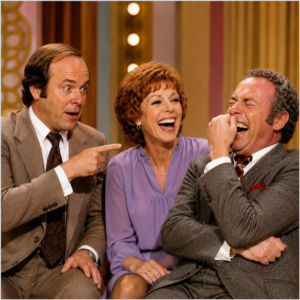
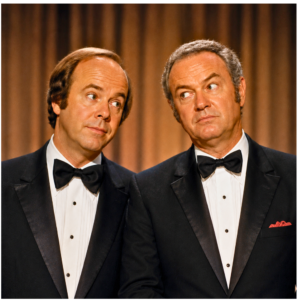
It wasn’t acting. It was survival. Every time Tim Conway stepped into a sketch on The Carol Burnett Show, Harvey Korman braced himself — because he knew chaos was coming. Tim had that quiet grin, that dangerous glimmer in his eyes that said, “I’m about to ruin your composure on live television.”… From the iconic “Dentist Sketch”, where Tim accidentally injects himself with Novocain, to the absurd “Siamese Elephants” story, Harvey would try — desperately — to stay in character. But every pause, every sideways glance from Tim, was a countdown to Harvey’s total collapse. He’d start trembling, turning red, tears forming as the laughter consumed him. The audience wasn’t just watching a show — they were watching two masters lose control together. Even Carol Burnett, usually the queen of poise, couldn’t always hold it in. There were moments she’d bend over, clutching her stomach, unable to say her next line. “Those weren’t rehearsed laughs,” she once admitted. “That was real joy. Tim made all of us forget we were working.”

here are comedy duos… and then there’s Tim Conway and Harvey Korman, the unstoppable chaos engine that turned The Carol Burnett Show into a weekly laughter explosion….

“HE MADE HER LAUGH FOR 50 YEARS — AND SHE CRIED ONLY ONCE: THE DAY HE LEFT.” 💔 When Tim Conway passed away, the world lost a comedy legend. But for Carol Burnett, it felt like losing the other half of her laughter. For decades, he could make her break character with just a look — that little grin, that spark in his eyes that said, “Here we go again.” Even in his final days, that same twinkle was still there. Carol sat beside him, held his hand, and whispered, “I love you, Tim.” No cameras. No laughter. Just two friends who had shared a lifetime of joy — saying goodbye in the quietest way possible. Sometimes the hardest part of comedy… is when the laughter stops.

Carol Burnett Remembers Tim Conway: A Friendship That Defined Laughter When Tim Conway passed away in May 2019, the world lost more than just a beloved comedian…

“IN ONE OF HIS FINAL INTERVIEWS, TIM CONWAY SETS THE JOKES ASIDE AND REFLECTS ON THE HUMBLE JOURNEY FROM AN UNKNOWN KID IN OHIO TO A COMEDY LEGEND WHO ONLY EVER WANTED TO MAKE PEOPLE LAUGH.” In a rare and heartfelt moment, Tim Conway appears not as one of his famous characters, but simply as himself. He looks back on his modest beginnings in Ohio, the early days of writing jokes that few people heard, and the quiet determination it took to keep going when success still felt far away. “I just wanted to make people laugh,” he says with the same gentle smile that defined his career. It’s a simple reflection — but also a touching reminder that behind decades of unforgettable comedy was a humble man who cared far more about bringing joy than chasing fame.

TIM CONWAY WON HIS 6TH EMMY AT 81 YEARS OLD. WHEN HE REACHED THE MICROPHONE, HE SAID NOTHING FOR 10 FULL SECONDS — THEN DELIVERED ONE LINE THAT DESTROYED THE ENTIRE ROOM. The audience expected a speech. Tim just stood there. Hands in his pockets. Staring at the trophy like he’d never seen one before. Ten seconds passed. Then twenty. People started shifting in their seats. Then he leaned into the mic and said: “I’d like to thank my wife… for not leaving me after the first five of these.” The room exploded. Three thousand people — actors, producers, legends — laughing so hard the camera shook. But what made it unforgettable wasn’t the joke. It was what he did right after, when the laughter finally stopped and the room went quiet again — and Tim Conway, for the first time anyone could remember, looked like he might actually cry.

Tim Conway’s Quietest Emmy Speech Became the Loudest Moment in the Room By the time Tim Conway won his sixth Emmy, the room already knew it was…

The moment Tim Conway begins speaking, you can see it — Harvey Korman already knows the scene is about to slip beyond control. On The Carol Burnett Show, what starts as a straightforward sketch gradually transforms into something far more memorable. Conway doesn’t rush the moment — he builds it. A subtle voice, a measured pause, a perfectly placed line — and suddenly the entire rhythm of the scene shifts. Korman does everything he can to maintain composure, but that tension is exactly what elevates the performance. As the props begin to misbehave and the situation grows increasingly absurd, the balance between control and collapse becomes impossible to hold. The audience feels it, the cast feels it — and that shared breaking point becomes the moment itself. It’s not just comedy; it’s timing, chemistry, and instinct unfolding in real time. The kind of scene that doesn’t fade, because it was never forced to begin with.

“I can’t stop laughing at this” is how many people still describe it — and for good reason. When Tim Conway and Harvey Korman step into The Old Doctor, what begins as a simple premise quickly becomes something far greater. Every pause, every misplaced step, every perfectly timed glance builds into a kind of comedy that feels completely effortless — yet impossible to replicate. Korman tries to hold the scene together, but that’s part of the magic. The more Conway leans into the absurdity with that calm, unshakable delivery, the more everything begins to unravel in the most natural way. It’s not forced. It’s not rushed. It just keeps building until the laughter becomes unavoidable. Decades later, the moment still holds its power — not because it’s loud, but because it’s precise. Two performers, completely in sync, turning a simple sketch into something unforgettable.

Leave a Reply

Your email address will not be published. Required fields are marked *