It began like a serious drama. Studio 33 went silent, the lights dimmed, and Carol Burnett — playing a self-important novelist — adjusted her scarf and faced her co-star with theatrical authority. Her character, the omnipotent Author, could control every move of her creation with a single word.
Enter Tim Conway, the “fictional” man she had written into existence — a mild-mannered character doomed to obey every line she typed. He stood there, confused, helpless… and already plotting mutiny.
What happened next was supposed to be a clever satire about a writer manipulating her characters. Instead, Conway turned it into open rebellion — a ten-minute comic breakdown so wild that even Carol Burnett herself couldn’t stay in character.
When the narrator (off-screen) commanded, “Rachel ran quickly — but hesitantly,” Carol followed, dramatizing every word like a soap-opera heroine caught in a storm. Then the narrator turned to Conway: “And her lover entered dramatically…”
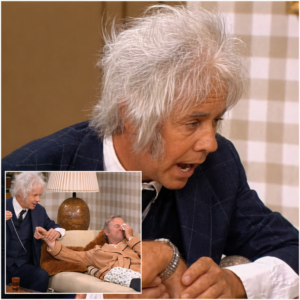
Conway froze. Blinked once. Then shuffled in at the slowest, most awkward pace imaginable — one deliberate step every five seconds, his body language somewhere between a confused flamingo and a man stuck in invisible mud.
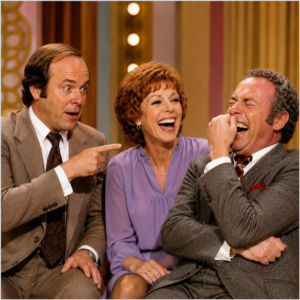
The audience was gone. Carol tried to keep going — lips quivering, voice cracking — but Conway doubled down. Every time the narrator described an emotion, he twisted it into a physical disaster: “He kissed her tenderly” became a near head-butt; “He embraced her passionately” turned into a bear hug from purgatory.
Burnett gasped between lines, whispering, “Stop it, Tim,” but he didn’t. He just kept escalating — rewiring the script, breaking the rhythm, and making the control room lose control.
By the midpoint, the entire scene had collapsed into glorious nonsense. Carol’s “powerful author” had lost all authority. Tim Conway was now the author, the editor, and the anarchist all in one. Every new instruction was a dare; every pause a trap.
And yet that was exactly why it worked. The Carol Burnett Show wasn’t just about scripted comedy — it was about watching brilliant performers gleefully destroy the script in real time. The moment Carol’s laughter broke, the studio erupted in applause. You could practically feel the cameramen shaking.
In the end, the scene wrapped with Carol clinging to her composure while Conway sauntered offstage, the triumphant survivor of his own fictional world. She looked at the audience and sighed: “And that, ladies and gentlemen, is why we don’t give him power.”
It remains one of the most perfectly derailed sketches in television history — a meta masterpiece about control that spun completely out of control. Because when Tim Conway steps into your story… the author never stands a chance.